


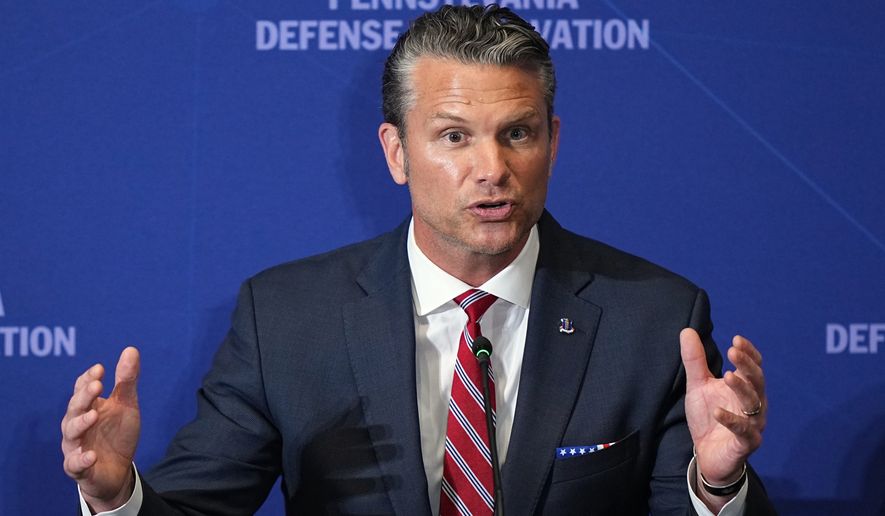

The Iran war has cost American taxpayers $37.5 billion, Defense Secretary Pete Hegseth told senators on Tuesday, but he warned that failing to “properly” fund the Pentagon is “probably the single greatest threat that our nation faces.”
The White House is asking for $67.1 billion in supplemental defense spending as part of a broader financial request. The extra money is intended to cover immediate military gaps while Congress debates the $1.5 trillion defense budget proposed for the next fiscal year.
“President Trump is following a simple logic: The military requires a generational investment to deliver on peace through strength. We know the best way to create peace is to prepare for war to deter it. That’s exactly what the Department of War is doing, building a force so capable that it would be absurd for anyone to challenge it,” Mr. Hegseth said, using the Trump administration’s name for the Department of Defense.
The secretary made it through less than a minute of his Senate testimony when it was interrupted by several anti-war demonstrators who were removed from the Senate hearing room.
Sen. Susan M. Collins, the Maine Republican who chairs the Senate Appropriations Committee, noted the divergent opinions of the panel’s members about the war. The Senate has taken several votes on the issue and will likely continue to do so, she said.
“But irrespective of our different views about the military operations, the fact remains that there are ‘must pay’ bills and urgent requirements facing the department that affect the ability of our troops to be well-trained, and more broadly, of the U.S. military to deter and defend against potential aggressors worldwide,” Ms. Collins said.
Some of the needs, such as replacing the shortfalls in munitions, have been well known, with bipartisan support in Congress to address the shortages, she said.
“While these munition shortfalls have been years in the making, they are growing increasingly urgent. We should not undermine the readiness of our service members,” Ms. Collins said.
Sen. Roger F. Wicker, the Mississippi Republican who chairs the Senate Armed Services Committee, said he fully supports the defense supplemental request and said he would work with colleagues on Capitol Hill to move it forward.
“We must ensure our service members have everything they need to face an increasingly dangerous world,” Mr. Wicker said in a statement. “This supplemental funding is essential in the near term to maintain readiness through training and military pay.”
The request would also accelerate the production of key capabilities, including hypersonics, strike weapons and drones, Mr. Wicker said.
“Supplemental resources will help ensure that our forces remain the most capable, lethal and ready in the world,” he said.
Sen. Patty Murray, Washington Democrat, accused the Trump administration of not being forthcoming about the “true cost” of the war and said it was money that could have been better spent elsewhere.
“Tax dollars we could have spent helping people afford health care or building new housing have now been lit on fire by a president who blundered us into a disastrous war,” Ms. Murray said. “The costs of this war have been astronomical, and what has it been for? What has actually been achieved? We hear a different rationale for this war every two days.”
The Pentagon’s new spending request is a direct result of the “neglected priorities and gross negligence” from the Biden administration, Mr. Hegseth said.
“President Trump inherited a set of global and domestic crises and deferred maintenance almost across the board,” he said. “Instead of steering the ship through gathering storms, former leaders let our military languish through social experiments and global sheer weakness.”
Sen. Jack Reed of Rhode Island, who is the top Democrat on the Senate Armed Services Committee, accused Mr. Hegseth of trying to excuse his “gross negligence” by blaming problems on the Biden administration.
“You did not fully inform the president that you would be in a situation where the Strait of Hormuz could be effectively closed, oil prices could surge, and … the Iranians could maintain their ability to strike back,” Mr. Reed said.
Mr. Reed asked Gen. Dan Caine, chairman of the Joint Chiefs of Staff, if he believed the air war against Iran could eventually mean boots on the ground.
“I think it’d be unhelpful for me to opine on hypotheticals,” Gen. Caine said. “What I can tell you is, we always develop an unbelievable amount of options and the associated risks. Then, my main job is to always ensure that leaders understand those options and the risks.”
Contact the author


Please read our comment policy before commenting.